
Tuesday, 12 June 2012

Reflections

After all that this semester have brought about, it has gotten me thinking of the direction I want to take when it comes to journalism and communication. I don't say journalism specifically because I'm not doing a journalism degree but instead, a Bachelor of Arts majoring in Journalism and Mass Communication. Thus, this, as my last post for JOUR1111, shall be a reflective one.
bibliophilia

In wake of the upcoming Fathers' Day, I've decided to do a book review on Darth Vader and Son by Jeffrey Brown. Saw a photo online about this book and I've been hell bent on getting in ever since and it finally came in the post last week! :) Seeing as how I'm a Star Wars nut, it was an absolute must-have as well!
 |
| Jeffrey Brown - Darth Vader and Son |
Monday, 11 June 2012
LAST LECTURE REVIEW: BRAND
“Create a BRAND for yourself.”
Steve Molks came in to do the last lecture of JOUR1111. He talked about creating a brand for ourselves as writers. How are we supposed to present ourselves as individuals?
This is especially important if we were to
undertake the mammoth task of blogging. First and foremost, what is our style?
Style here doesn’t mean fashion, of course. It refers to the way we write. If
we carefully read blogs that we frequent, we should be able to tell two
different bloggers apart. Firstly, in the writing style, this could encompass
the tone, vocabulary, forms of expressions etc. Next, for every blog, it is
clear that there is a certain demographic, or audience, that is targeted. This
can be a general audience, or a very specific audience. For example, one can be
writing for all women, or only for women between the ages of 20 – 30.
Of course, before blogging, we have to
establish a platform – do I want to do video blogging? How about pure text
posts? What mode or hosting site should I use? All these questions have to be
answered before anything else. And from there, we start publishing our own
stuff.
You see, the good thing about owning your
own blog is that YOU are the publisher, the editor and the writer. YOU control
your own blog. And of course, that is the downside as well but hey, truthfully?
It’s all worth it.
Steve mentioned that when we have our own
blog, we have to write constantly. This refers to the frequency of our posts,
and also the topics we write about, for example, fashion, television or arts
and crafts. This is to establish a rapport with your audience and also, it
helps to make an impression in the “blogosphere”. Let’s be honest here, nobody
wants to read a blog about nothing in particular that is updated like, what,
once a month? No, people want a theme; they want to keep coming back because it
is something they can relate to. Also, by updating regularly, this will promote
a healthy flow of traffic to your site, and it helps that people are less
likely to forget about your blog.
Lastly, in the lecture, Steve talked about
sources. We have to verify our sources, who are they and what authority do they
have. Also, words taken or quoted directly from a source is more powerful then
the words written by the writer / journalist. That is, people will be more
inclined to a direct quote as a quote paraphrased by the writer.
In short, you, as a writer,
WHAT IS YOUR BRAND?
Sunday, 10 June 2012
LECTURE 11 REVIEW: INVESTIGATIVE JOURNALISM
“An investigative journalist … to discover
the truth and to identify lapses from it in whatever media may be available.”
~ Hugo de Burgh, 2000
Investigative journalism comprises of 5
“INs” – IN-telligent; IN-formed; IN-tuitive; IN-side (or IN-timacy); and
IN-vest. Of course, it is also about the main “IN” – IN-vestigate. To do
investigative journalism, one must know the facts beforehand and not just go
barging right in. You have to develop a keen sense of intuition and learn to attain
trust from people on the inside. Naturally, you have to be prepared to invest a
lot of time, money, resources and even, relationships. You have to be prepared
to take risks. No one ever said investigative journalism was going to be easy.
What is investigative journalism, and what
is its purpose?
- Critical and thorough journalism
The key idea is ACTIVE INTERVENTION. Journalists must be active participants and make substantial effort when undertaking investigative journalism. - Custodians of conscience
The key idea is EXPOSURE. The investigation journalists do must expose “civic vices” for the society to react to. - To provide a voice for those without one
and to hold the powerful to account
The key idea is PUBLIC INTEREST. Social justice is the main aim for investigative journalism. - Fourth Estate / Fourth branch of the
government / “Watchdog”
The power of the government has to be balanced and journalists represent these interests of those without power, journalism takes checks on the other branches of government, the judiciary, executive and legislature, to ensure transparency and lastly, journalists have a duty to hold people and institutions in power accountable for actions that impact the society.
“Be sceptical, not cynical.” – this is what
investigative journalism is about. It is not about slamming or criticising
everything but being sceptical, taking things with a pinch of salt and if there
are indeed suspicious business going about, expose it. Everything is not to be
taken for granted and journalists have to stand back and observe the big
picture.
“It is not enough for journalist to see
themselves as mere messengers without understanding the hidden agendas of the
message and myths that surround it.”
~ John Pilger
As an old journalism saying goes, “if your
mother says she loves you check it out.” Journalists have to always check their
facts, and check it again. We should never assume anything. We can do this by
interviewing and observing, analysing documents and of course, triangulation.
Does everything up to that point – what you were told, what you saw, what you
recorded etc., all line up? Check, check, and check again.
Of course, investigative journalism in
modern times is facing threats. The most prominent one is definitely the lack
of resources. Online news is primarily the cause of this. Due to online news,
less revenue and money are made by news organisations. This, in turn, means
less journalists and less time are available to do reporting and thus, less
investigative journalism is done.
Secondly, public relations (PR) is also
another menace to investigative journalism. PR is all about propaganda as a
tool of selective use of ‘facts’ to present a case to the general public, and
usually a very persuasive tool. On the other hand, journalism needs to verify
the ‘facts in the public interest’. With the growth of PR out there constantly
feeding selected facts to the public (and the media), there is a shrinkage in
journalism.
So, what lies in store for investigative
journalism? Youtube recently launched a channel “tailored to investigative
journalism” but I’ve checked that out and truth be told, the whole thing seems
a little dodgy.
However, there is The Daily Mail, which
does investigative journalism. For the moment it is going strong but really, what
will happen if resources run out for it? But, let’s try to see on the bright
side, if it is out there long enough and people start taking notice, that might
just be the boost we need to get the ball rolling on investigative journalism
again.
Saturday, 9 June 2012
I enjoy reading.
Hey people, here's another book review seeing as how I'm still procratinating!
This book is Survivor by Chuck Palahniuk.
 |
| Chuck Palahniuk - Survivor |
Thursday, 7 June 2012
LECTURE 10 REVIEW: AGENDA SETTING
Agenda setting – now this is one hot topic
in journalism studies.
“Agenda setting is the process of the mass
media presenting certain issues frequently and prominently with the result that
large segments of the public come to perceive those issues as more important
than others. Simply put, the more coverage an issue receives, the more
important it is to people.”
~ Coleman, McCombs, Shaw & Weaver
(2008)
People’s idea of reality is influenced by
external factors. These factors can be society and the media. The way we
perceive reality is mediated through our social life and the media. There are
four agendas when it comes to agenda setting – the public agenda, policy
agenda, corporate agenda, and media agenda. These four agendas are
interrelated.
The “original” reality directly influences
the “media reality” and the “public reality”. Reality can originate from the
society, the economy, the political and so on. These issues are transmitted to
the media via Public Relations (PR) and direct influence. Through selection
processes and inter-media agenda setting, the media transmits the information
they want to the general public. The public form their own construct of reality
via direct impressions and daily social interactions and of course, from what
they gather from the media.
There are 2 basic assumptions of media
agenda setting – mass media filter ad shape reality, and media concentration
affects the perception of importance of certain issues. Walter Lippman states
that propaganda (through the media) is a tool that shape images in the minds of
people in support of enterprises, groups and ideas. The hypodermic needle model
definitely supports that statement. It is said that mass media is like a
needle, “injecting” influences in the minds of audience to form certain images.
Lippman argued that people should think critically for themselves rather than
form judgments based on images the media feed us.
“The press may not be successful much of
the time in telling people what to think, but it is stunningly successful in
telling its readers what to think about.”
~ Bernard Cohen, 1963
Agenda setting theory can be broken down
into two levels. Level one is where the media suggest WHAT we should focus on.
Level two is where the media suggest HOW we should think. What agenda setting
does is to transfer the importance of certain issues from mass media to the
public. Also, elite media often have influence over what other media publish.
As Dr Redman said, the media set the agenda simply because they can.
Agenda setting comprises of 7 components.
- Media gatekeeping is about how and what the media chooses to report to the public.
- Media advocacy is the use of the media to promote certain messages to the public.
- Agenda cutting refers to the fact that though there are so many issues in the world to report on, the media only reports on some. Thus, certain important issues lose their significance because they are overshadowed by other shallow news.
- Agenda surfing is simply the media jumping on the bandwagon by following what the current trends and reporting on what the general public wants.
- The diffusion of news is about how, when, where news are released. Are certain news released immediately after they happen? Or do we wait a few days before announcing it to the public?
- Portrayal of an issue encompasses the fact that the way issues are portrayed by the media affects the way the public perceive them.
- Media dependence is critical because a person is more susceptible to media agenda setting if he is very dependent on the media for information.
The current focus on agenda setting
nowadays is the 24hours new cycle. With the internet and cable news (especially
with 24hour news channels), who influences who when it comes to agenda setting?
In the old days, newspapers set the agenda of the day. They were printed and
distributed in the morning, and that affected the other news outlets like
radio. Nowadays, with the various outlets of news like social networks, how can
we be sure who influences who?
The bottom-line of agenda setting can be
reduced to one simple question, which I will leave you with. The main point of
agenda setting is:
“WHAT’S BIG AT THE MOMENT?”
Wednesday, 6 June 2012
A worm through my books
I'm currently procrastinating about the past few JOUR1111 lecture reviews so I thought that it'd be nice to do a book review as well, I love books.
The book I'm going to review is Coin Locker Babies by Ryu Murakami.
 |
| Ryu Murakami - Coin Locker Babies |
Thursday, 24 May 2012
ANNOTATED BIBLIOGRAPHY
Golan, G. (2006).
Inter-media agenda setting and global news coverage. Journalism Studies, 7(2), 323 – 333. doi: 10.1080/14616700500533643
This article is a study by Guy Golan on inter-media agenda setting. Golan discusses that the newsworthiness of international news can be determined by inter-media agenda setting. This study was done because Golan felt that not much research has been conducted regarding this topic. Golan advises that scholars should consider inter-media agenda setting more in future research. He also advises that there should be raised concerns with regards to the notion that elite news agencies can be highly successful in determining another’s news agenda. Lastly, he concludes that there is an imbalance in international news coverage of nations and stresses the importance of studying how news coverage affects public perceptions of nations.This journal article is short and concise with ample background information to understand the topic better. However, it is too brief. Golan could have done more when explaining his results. Also, this study was too focused on proving that inter-media agenda setting does exist. As a result, the other part of the research, which was to identify how international news’ newsworthiness is affected by inter-media agenda setting, was neglected.
Friday, 11 May 2012
MOVIE DATES...
or not.
I'm gonna be doing a post about movie dates, seeing as how there's an influx of awesome movies hitting the cinemas these weeks...
Have you ever gone to the movies and got so irritated by the people sitting around you (including the people you went to the movies with)? HELL YEAH, I'm pretty sure you guys have at least experienced this once, or twice, or more than thrice (oh you poor soul). So, here's a list of people I'd never wanna catch a movie with. EVER.
#1: COUPLES
CRIME: PDA in the cinema
You lovebirds out there, if you wanna make out, PLEASE GET A BLOODY ROOM. I implore you to keep your funny business to the bedroom. There's nothing that gross out (or annoy) a person more than to hear you both sucking each other's faces while they're trying to watch a movie. Really. This has happened to me too often. It's either them kissing, or giggling, or I actually have no idea what they are doing and I plan to keep it that way! Them being at the back, or at the front (which is actually worse) is HORRIBLE. They're the reason why a perfectly good movie experience is destroyed. Yes, sadface ): There goes my $6.50, wasted.
SENTENCE: THROW POPCORN AT THEM!!!
#2: KIDS
CRIME: Screaming, crying, whining, yelling, talking etc., in the cinema.

I'd understand if it was a movie for kids but parents, why would you bring your kids to watch a movie like, say, ALIENS VS PREDATORS (yes, I know this is an old movie but the experience still haunts me)?!?! They'd just sit there and cry or scream at scenes. Or continually ask questions about what is going on? Or, has the movie ended yet? Not to mention the classic: Mummy, I need to pee pee... Really, I want to enjoy my movie experience fully, in peace. I don't wanna listen to the continuous prattle of your child while I'm trying to watch my show!
Not to mention, kids are really clumsy. They might even spill their drinks on you (which, unfortunately, happened to me). At which point I was so pissed off, I yelled at them. Yes, I'm a child-hater, guilty as charged. But if they weren't so annoying most of the time, I might actually find them, alright.. But no, they have destroyed one too many movie (and flight) experiences for me. So, keep them away I say, KEEP THEM AWAY!
SENTENCE: YELL AT THEM TO SHUT UP. Or just sit far, far away...
#3: MR KNOW-IT-ALL
CRIME: Talking. At every scene. Trying to tell you what's going on, and what's gonna happen.

Thanks but no thanks. I'd rather find out what goes on all by myself. I really do not need a live commentary while I'm watching a movie. I do not need to know that the hero is fighting the villian right now, I do not need to know who wins after that, I do not need to know whether the hero always get the girl. Really, I'm there with you, YOU DO NOT HAVE TO TELL ME.
This is really one that gets on my nerve. And this is especially so, because they are normally people you go to the movie with. A random stranger is, most of the time, not gonna suddenly start blurting out all these while he's sitting next to you. No, this category of movie-pariah is often, surprise surprise, your friend. Yes, there, I said it.
SENTENCE: NEVER EVER EVER, invite him/her to the movies with you. Or, just, avoid sitting next to them. No really, I'd rather watch a movie alone...
#4: CRAZY FANGIRL
CRIME: OMG HE'S SO HOT. OMG OMG OMG, I CAN'T STAND IT. *insert unintelligible screams*
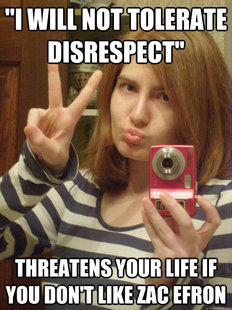
NO SHIT SHERLOCK, TELL THE WHOLE CINEMA WHY DON'T YOU.
This category of movie-leper speaks for itself. They should be avoided at all costs. Nobody wants to watch an entire movie whilst listening to you gush over how hot Zac Efron is, or how wonderfully looking Chris Hemsworth's abs are, or how you'd totally sleep with Taylor Lautner if given the chance.
NOBODY. WANTS. TO. KNOW.
If you're just watching to gush non-stop over that dude, save your money. Go home and stare at a picture, it'll last longer... Also, it'll spare me the horrible nightmares I might get when I try to sleep later that night.
These kinda people, can be random dumb people in the cinema, or they might even be your friend.
SENTENCE: AVOID AT ALL COSTS. Because, really, who wants to listen to the musings of an sexually-fueled airhead? Either you NEVER invite them, or well, I'd love to say hightail out of the cinema at the sign of any fangirling activity, but that's just money wasted...
But, hearing them fangirl throughout the whole movie is practically money wasted as well....
#5: THAT BLUR COOT.
CRIME: "Errr, what's going on? What's happening? Who's dead? Why are they kissing? Is that the good guy or the bad guy?"

Yes, THAT BLUR COOT.
I understand you're slow but you see, I'm watching the movie as well, so I can't really answer you. And I really do not want to answer you... I can explain it to you AFTER the movie, but not DURING the movie.
Why not? Firstly, it's annoying. Secondly, I'm also trying to follow what's going on. Thirdly, I JUST DON'T WANT TO. So, there.
It's annoying if I'm the one they're directing all their questions to. And it's also annoying if I'm siting near a random stranger who keeps asking her/his friend these questions. Bottomline? It's annoying.
SENTENCE: As per the previous ones, DO NOT INVITE. Or tell them to shut up.
#6: FACEBOOK ADDICT
CRIME: having to add their own comment and opinion on EVERYTHING. DURING THE MOVIE.
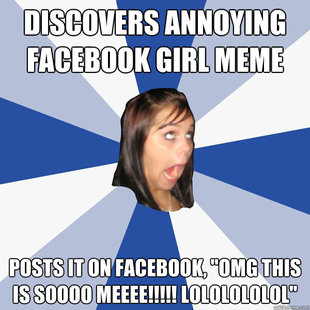
*guy dies* "WHY DID HE HAVE TO DIE? THAT'S JUST STUPID."
*special effects scene* "OH, NO WAY. THAT LOOKS SO FAKE."
*kissing scene* "EEW, they aren't even compatible!"
*fight scene* "Pssht, how can he not be bleeding."
*shooting scene* "No way he doesn't die from that."
*random scene* "THIS ISN'T EVEN IN THE BOOK."
and so on... You get the idea. This person simply has everything to say about every damn thing in the movie. Keep it all in your head tyvm, I don't wanna know what you think about it.
SENTENCE: I'm pretty sure we have all had (yes, past tense) a friend who is guilty of this. UNFRIEND.
#7: POSEUR CRITIC
CRIME: Breaking down the entire movie into bite-sized parts to criticize and tear apart after watching the movie.

Yes, this is another category of movie-retards you never wanna catch a movie with. They can make a horrible movie seem even more ghastly than it already is. They can make an alright movie seem horrible. And they can make an awesome movie look bad.
In short, they make your movie experience terrible at the end of it all. You might feel happy, sad, slightly chagrined after a movie, but these people? They make you feel HORRIBLE. They make you feel like you've just wasted a couple of hours of your life watching a crappy movie (which, was actually really good).
They harp on every single detail, right down to the colour of the lead female's nail polish. And they have an endless flow of criticisms about the movie. Sure, they might have a few praises but ha, how naive you seem. Their negative comments outweighs their positive ones. Just being around them will drain you of any happiness the movie provided. They don't bother you during the movie but they sure as hell are going to after the movies.
SENTENCE: admit it, you're bound to have a friend who's like that. So yes, if you are gonna invite them to the movies, set some ground rules. Or tell them to shut their trap. Or just stop inviting them. And they might get the hint... Or not.
#8: NUMBER #1 FAN, ON CONTRACTUAL BASIS.
CRIME: claiming to be the number #1 fan of the show, the book, the series, the actors or actressess, the director etc. after the movie.

They can never name what other movies the actors/actresses acted in. Or what other movies the director has directed. Or the other movies in the series. Or have never read the book.
And yet, "OMG I'M THE BIGGEST FAN OF THIS EVERRRRRR!!!"
Really, do we have to go down this path, again? You do this after every single movie for god's sake. Or maybe selected movies but still! NUMBER #1 FAN? REALLY?! PUHLEEZE, you didn't even know there's 7 Harry Potter books for god's sake. Do us a favour, and shut your piehole.
You can state and gush and vomit rainbows over how awesome the movie is, and how you'll totally watch the other movies but NEVER, EVER, claim to be the biggest fan just after 2hours in the cinema. It's hugely annoying. And a really poseur thing to do. DO NOT JUMP ON THE BANDWAGON. Only to hop off after the hype dies off you shallow bitch person. It's a huge insult to the genuine fans out there.
SENTENCE: ROLL YOUR EYES AND WALK AWAY. TOTALLY IGNORE. Or just do it simple: NEVER INVITE THEM OUT.
#9: I CAN'T HOLD ALL THESE FEELS
CRIME: too much emotions.

Yes, these people. Who can't seem to hold it all together. They have to cry at every sad scene, laugh at every happy/funny scene. Stay on the edge of the seat at every action seat. Cover their eyes and scream and every scary scene. And continue to do that even after the movie ends, whenever you guys talk about the movie. Extended emotions from a movie, ain't cool.
But mostly, they just cry. A lot. Someone died? Cry. Someone breaks up? Cry. Someone loses a battle? Cry. Someone had a touching moment? Cry. Everything, cry cry cry. At first it'll be alright. And then you'll just start getting annoyed every time they sniffle. Trust me on this.
SENTENCE: They're mostly harmless though. I'd say it's fine to watch a movie with them, but choose wisely which movies to watch. Although they pretty much find all sorts of stuff to cry about. Apply in small dosage.
#10: RIDING THE BANDWAGON
CRIME: going crazy over a movie that is the current "IN" thing.

Yes, those kind. You know? The kind that has never read Hunger Games before but is "SO PSYCHED FOR THE RELEASE BECAUSE I TOTALLY LOVE IT." They are different from the temporary #1 fans.
They will read up all about the movie and stuff like that, but will never actually read the book. They will not get what the movie is about, but they'll randomly spout stuff they picked up off Wikipedia or film reviews. They will have no idea what is going on, but will act like they know everything and can't wait to share all their views with people. And express how much they love it.
In short, FAKE FAKE FAKE. They will try to impress you with their reservoir of knowledge but you just couldn't care less.
SENTENCE: Don't bother with them. Do not falter, they'll go in for the kill. AVOID, Right from the start.
And, well, that's all I can think of for the moment. In my opinion, these kinda people should be banned from ever watching any movies. But hey, that's just what I think.
Hope you enjoyed this! :)
Till then, cheers.
Tuesday, 8 May 2012
LECTURE 9 REVIEW: NEWS VALUES
"If it bleeds, it leads!"
That statement pretty much sums up most news values, to be honest.
News values are the degree of prominence and attention we pay to a story, regardless whether we are journalists or the audience.
So, what are news values? They are:
i) IMPACT
ii) AUDIENCE IDENTIFICATION
iii) PRAGMATICS
iv) SOURCE INFLUENCE
From there, we are lead to newsworthiness. As A. Boyd said:
"News journalism has a broadly agreed set of values, often referred to as 'newsworthiness'..."
The main question here is
Are news values the same across different news services? How about across different countries/cultures?
NO.
News values differ across all platforms. However, what remains constant is that they always follow the inverted pyramid.How are news values shaped? Do the individual journalists have roles to play? Or is it just the big media moguls who decide all these? A lot of people will argue that journalists rely largely on their instincts rather than logic when it comes to what is newsworthy or not.
"A sense of news values is the first quality of editors - they are the human sieves of the torrent of news, even more important than an ability to write or a command of language."
~ Harold Evans
Galtung & Ruge (1965) identified 12 Factors of Newsworthiness:
- Negativity (bad news)
- Closeness to home - proximity (how does audience relate)
- Recency (e.g. breaking news!)
- Currency
- Continuity - events that continue (e.g. war)
- Uniqueness
- Simplicity
- Personality (centered around a particular person)
- Expectedness (& predictability)
- Elite Nations / People
- Exclusivity
- Size (yes people, SIZE DOES MATTER!)
All these factors were further developed on through the years and most recently, Judy McGregor reduced the 12 factors to only 4 bases in 2002, where she brought up a curious point - celebrification of the journalist.
Threats to newsworthiness have identified 3 tensions:
i) Journalism vs commercialisation of media and social life
ii) Journalism vs Public Relations
iii) Journalism's Ideals vs Journalism's Reality
These 3 points draw towards the fact that journalism has become lazy and incompetent; the PR influence over journalism has somehow made the whole thing a tabloidisation; and of course, hyper-commercialisation. All of these therefore assert pressures on the newsroom and in term, to put it bluntly, crappy work is produced.
To prove a further point, the term "Churnalism" has been coined. It refers to stuff coming from PR outlets as PR is influencing journalism more and more nowadays.
We, as journalism students, have to take note that there is a difference between an idealised notion of journalism that we have, and the harsh reality of the newsroom. What we expect is often not what we can get.
Lastly, the people formally known as "The Audience"...
HAVE THEY MOVED ON?
So, what does this hold for the future of news values?
Oh, and one small thing, just before I go... Remember how Dr Redman was talking about the factors of newsworthiness and he mentioned that "DOG BITES WOMAN" is not as interesting as "WOMAN BITES DOG"?
So yeah, next thing you know, "WOMAN BITES DOG" makes the news headlines the next day...
 |
| Drunk US woman charged over biting dog. http://www.channelnewsasia.com/stories/afp_world/view/1198468/1/.html |
And that's all folks!
LECTURE 8 REVIEW: ETHICS
Before I begin, here's an advertisement!
Dr Harrison did the lecture on ethics with us. It kicked off with a couple of questions:
How do we tell the difference between the bad, the wrong, and the simply tacky?
And of course, there are those really sleazy ones that make your hair stand on its ends.
To get a rough gauge of how we view ethics, we had a small exercise during the lecture where we were shown print and video ads, and were asked to grade them on a chart. I'd have to say, some of the ads were downright BAD. Some were boring but ethical, some were unethical but good, some were good ethical. Question is, how do you draw the line at producing a good advertisement without compromising your morals, or the public's morals for that matter?
There are 3 paradigms of Ethical Theories - Deontology, Consequentialism, and Virtue.
Deontology (now trying saying that outloud 10 times, quickly)
is basically about rules, principles and duties. It is all about doing the right thing by following those guidelines. Thus, all ethic codes are generally deontological.
On the other hand, Virtue Ethics
is all about "goodness", or happiness. They come from good habits and dispositions of characters. These habits are what constitutes to "virtues", like courage, temperance and so on. It is an intrinsic theory as compared to Deontology.
Lastly, Consequentialism (or Teleology)
I was so excited when I saw the word, inner POLS geek in me was screaming "HEYYY I KNOW THAT, YAY ME." so loudly that I thought Dr Harrison might send me out of the room.
It is simply about: the ends justify the mean.
The only thing that matters is that the right outcome is achieved, it is irrelevant how we got there.
Of all, Virtue Ethics contributes to the Golden Mean of behaviour. (don't you just love that phrase? It seems all, shiny) HANDS UP THOSE OF YOU WHO THOUGHT OF A SHINY GOLDEN EGG WHEN YOU SAW THOSE WORDS! Or am I the only one who thought of that? ):
Anyway, back to the Mean...
For example, courage is the mean between rashness and cowardice, and justice is the mean between the injustice of overzealous and excessive law, and the injustice of lawlessness. Oh boy, was that a mouthful of words.
To sum it up, ethics is essentially about the "balance". How do we know when we've crossed the line? In fact, how do we know where the line is? There's a fine line between what is ethical and what is not, and especially so as it is a very subjective matter.
Before I leave, I'll leave you with this question Dr Harrison posed to us:
Now just think about that.
And that advert at the start...
Dr Harrison did the lecture on ethics with us. It kicked off with a couple of questions:
How do we determine what is:
GOOD / BAD?
ETHICAL / UNETHICAL?
RIGHT / WRONG?
How do we tell the difference between the bad, the wrong, and the simply tacky?
And of course, there are those really sleazy ones that make your hair stand on its ends.
To get a rough gauge of how we view ethics, we had a small exercise during the lecture where we were shown print and video ads, and were asked to grade them on a chart. I'd have to say, some of the ads were downright BAD. Some were boring but ethical, some were unethical but good, some were good ethical. Question is, how do you draw the line at producing a good advertisement without compromising your morals, or the public's morals for that matter?
There are 3 paradigms of Ethical Theories - Deontology, Consequentialism, and Virtue.
Deontology (now trying saying that outloud 10 times, quickly)
is basically about rules, principles and duties. It is all about doing the right thing by following those guidelines. Thus, all ethic codes are generally deontological.
On the other hand, Virtue Ethics
is all about "goodness", or happiness. They come from good habits and dispositions of characters. These habits are what constitutes to "virtues", like courage, temperance and so on. It is an intrinsic theory as compared to Deontology.
Lastly, Consequentialism (or Teleology)
I was so excited when I saw the word, inner POLS geek in me was screaming "HEYYY I KNOW THAT, YAY ME." so loudly that I thought Dr Harrison might send me out of the room.
It is simply about: the ends justify the mean.
The only thing that matters is that the right outcome is achieved, it is irrelevant how we got there.
Of all, Virtue Ethics contributes to the Golden Mean of behaviour. (don't you just love that phrase? It seems all, shiny) HANDS UP THOSE OF YOU WHO THOUGHT OF A SHINY GOLDEN EGG WHEN YOU SAW THOSE WORDS! Or am I the only one who thought of that? ):
Anyway, back to the Mean...
For example, courage is the mean between rashness and cowardice, and justice is the mean between the injustice of overzealous and excessive law, and the injustice of lawlessness. Oh boy, was that a mouthful of words.
To sum it up, ethics is essentially about the "balance". How do we know when we've crossed the line? In fact, how do we know where the line is? There's a fine line between what is ethical and what is not, and especially so as it is a very subjective matter.
Before I leave, I'll leave you with this question Dr Harrison posed to us:
"Is it more important to follow rules, or go by what you believe in? As a journalist, are codes or character more important?"
Now just think about that.
And that advert at the start...
ETHICAL? OR NOT?
Thursday, 26 April 2012
A Love Like This...
You’d
think loving somebody is tough. So how about being in a polygamous relationship?
Think about it, how would you feel, and cope, if you were not the only person
in your partner’s love life?
Meet
this lady:

She’s
my grandmother. And that man beside her? He’s my grandfather. The thing is, she’s
not his only wife. She’s his first wife through an arranged marriage. Years
later, my grandfather would go on to marry 3 other wives but, 2 of them ran
away with other men. Back when polygamy was legal in Singapore, the first wife
had to go to court to affirm that she allows, and doesn’t mind that, her husband
gets another wife. If this didn’t happen, the man would not be able to. Imagine
how my grandmother must have felt, watching her own husband repeat this over
and over again, and having to go to court for him.
One might
argue as to why couldn’t she just disagree to it. Here’s why: this happened
almost 70 years ago and nonetheless, in Singapore. Back then, women were oppressed
– they had no say. Especially in an Asian household, the wife had to dutifully
listen to not only her husband but also, her in-laws. She had no authority until
she was the dowager herself.
To
understand the dynamics of polygamy, imagine this:

This
is exactly how it happened for my grandma. Her responsibility in the household
was the greatest; and her in-laws dealt with her the strictest. Meanwhile, my
grandpa did nothing to help and instead, pampered his other wives.
 |
| Grandma's posse - biological & step-daughters, and daughter in-laws |
Yet
throughout it all, the love my grandmother had for her husband, and her
children, stood resolute. Despite her in-laws constantly berating her for not
giving birth to a boy, her love did not waver. When she adopted 2 boys, she looked
after them as if they were her own children. Their own parents didn’t think
twice about them but not my grandma. She loved my uncles as if they were her
own flesh and blood. When my grandpa chose to live with his second wife instead
of her, she persevered, and never once did her love for him falter. When she had to look after my grandpa’s other
children with his second wife, and then when they turned against her under
their own mother’s instructions, she still continued loving them.
 |
| It's the clan, minus a few... |
Even
now, after one of her daughters succumbed to cancer, and her husband about to, she
continues to love. In fact, her love has intensified. Despite everything, my
grandma’s love did not waver once. She did not question, she did not doubt. All
she did was to faithfully continue loving without asking for anything in return.
She loves all of us, regardless whether we are smart or mentally unsound,
regardless of our background and regardless of what we do. I know for sure that
no matter what happens, my grandma will continue to love those she holds dear.
So,
how often do you see a love like this; so unwavering, so steadfast? To give
your all and not once expect or ask for anything in return, to selflessly love
no matter what. An unconditional love like this is something so precious. If I
were in my grandma’s shoes, I would have given up on love long ago.
My
grandmother inspires me to want to be a better person, to love and to give
without hesitation and pause. All I ask, is that she’s still around to see me
get married. I just want to see her smiling face on my wedding day.

I really do.
Friday, 20 April 2012
Thursday, 19 April 2012
STEREOTYPES. AND BULLSHIT.
This has been getting more and more on my nerves since I’ve arrived in Brisbane. Firstly, I’ll first admit I do enjoy the occasional racist joke and even partake in some racist jokes sometimes but, there is a fine line and YOU DO NOT WANT TO CROSS THAT LINE. What does that line border on? Joking around and being completely insistent on a stereotype.
Let me illustrate by this:
It is completely fine to have those jokes (especially those online nowadays) that go shows somebody doing something and the caption states – LEVEL: ASIAN. I’m completely fine with that. In fact, I laugh along to it as well. But to completely cloud your mind and insist on a stereotypical view of an Asian is a bloody turn-off. For example, we do NOT all speak CHING CHANG CHONG. In fact, CHING CHANG CHONG DOESN’T EVEN MAKE SENSE IN ANY DAMN ASIAN LANGUAGE.
Why am I talking about this now? Well, I thought I could tolerate all these questions from people since I arrived here but no, I’ve reached my limit already. Today, for the 145810475145th time (I know I’m exaggerating, so sue me), someone asked me about the weather in China and whether I understood English. It’s fine if you enquire about my understanding of the English language but it is NOT FINE to assume I’m from China, just because I’m Asian. Really, I don’t look at people in Australia and ask: ARE YOU FROM THE US? No, I just don’t lump all of you white people (a little racist but still) into the great big place called the United States of America. Likewise, you should not just assume I’m from China because I look Chinese. I mean, for goodness sake, we Chinese, Japanese, Korean etc all look alike anyway! So please, do not lump all of us together. We are all completely different. Like you guys, we have different customs and language and slang and so on.
Also, English is the first language in Singapore. I understand that most people do not know this so I forgive all of you. But when I speak in English, do not just blurt out: WOW, you speak really good English for a Singaporean. You can comment on how good my English is, but do not associate it with my country. I understand "you speak good English" but I just don't get why people must automatically add "for a Singaporean" at the end. And when I say that English is our first language, really, it's not a big deal. Don't give me the jaw drop wide eyed look. Seriously.
Also, English is the first language in Singapore. I understand that most people do not know this so I forgive all of you. But when I speak in English, do not just blurt out: WOW, you speak really good English for a Singaporean. You can comment on how good my English is, but do not associate it with my country. I understand "you speak good English" but I just don't get why people must automatically add "for a Singaporean" at the end. And when I say that English is our first language, really, it's not a big deal. Don't give me the jaw drop wide eyed look. Seriously.
Another thing is guys, I’m from Singapore. Singapore is a small island country at the South-Eastern peninsula of Asia. WE DO NOT BELONG TO CHINA. WE ARE NOWHERE NEAR CHINA SO PLEASE, STOP ASKING US THAT. Singapore enjoys good tourism, trade and military relations with Australia so there is NO EXCUSE to mistake us for some part of CHINA. Really, this is one of the points that irks me the most. You can ask me: Where is Singapore? But do not ask me: Are you guys part of China? In fact, here's a map for you:
 |
| As you can see, Singapore is far from China |
Next, being Asian doesn’t automatically make me SMART. I don’t get straight As, I do fail subjects. Don’t give me that shock face when I say that or tell me: BUT YOU’RE ASIAN. People, I will bitch slap you. I don’t look at you guys and say: WOW YOU GUYS ACTUALLY CARE ABOUT SCHOOL based on the stereotype that Australians are lazy right? So yes, you would not like someone to say that about you so please do not say that about me/ other Asians.
Yes, I am doing a Bachelor of Arts. No, I’m not doing Business or Sciences or Economics or Medicine. JUST BECAUSE I’M ASIAN DOES NOT MEAN THAT I HAVE TO PURSUE A DEGREE IN THOSE AREAS. I’ve had more people come up to me and immediately say: “Hey, are you in Business?” as compared to the people asking me: “What are you studying in uni?” So yes, please do not give me a shocked face when I say I’m doing Arts. I find that really insulting.
Yes I’m Chinese but no, I’m a Singaporean. They are not the same thing. My race is Chinese, my nationality of Singaporean. Just because I’m Chinese doesn’t mean I’m from China. Also, just because I’m Chinese (or even Asian for that matter), I do not eat dogs and cats. In fact, we don’t even eat those in Singapore. I don’t mind (sometimes) if you ask me: Do you guys eat dogs and cats in Singapore? But I definitely mind if you immediately go: EEW, YOU GUYS EAT DOGS AND CATS. Also, I do acknowledge that we Asians do eat some pretty weird food (like pigs intestine or fish eyes). However, this does not give you guys are free pass to comment and constantly go EEEW this is gross that is gross all the damn time. We do not make you eat those stuff, in fact we do not even eat it over here. So please, you can say it once, but don’t keep repeating it over and over again like a broken record. It is not only insulting but also, annoying.
Also, Asians have a thing called Filial Piety. No, it doesn’t mean we are goody two-shoes. It means we respect our parents. We are very family oriented. When we say something, or when we do things in respect to our parents’ wishes, and even if that goes against what you wish to do (for example, we might decline to stay out late everyday partying), that still does not give you the right to keep on dissing us, and our parents, and our customs. I’ve heard people go: “Oh you guys and your Asian parents, forever so strict. That’s so dumb, they’re so dumb. Why can’t they let you go out and party? That’s just stupid.” Yes, I’ve actually heard people say that to me before and I’ll tell you, it took me a lot of willpower not to slap that bastard (for lack of a better word) in his face. You might not understand it, so try to understand it. Do not immediately just shoot your mouth off. Because then, you’ll just look like one big fat idiot.
People have to understand that they are not the center of the universe. The world does not revolve around them. Their race is not superior to other race. Just because their race might sometimes be slightly more affluent than others does not mean they can constantly rag on others. For goodness sake, this is the 21st Century already, can’t people just be more open-minded these days? There are tons of people moving across borders to live, work, study etc. Being narrow-minded and closed to the difference between people is just dumb. Always attempt to understand others and where they’re coming from, what values and virtues guide their life. You might not agree with it but at least, respect it. The day that people humble themselves and attempt to further understand others, it will be wonderful. As Bono said:
“To be one, to be united is a great thing. But to respect the right to be different is maybe even greater.”
That’s really all I’m asking for; just a little more respect. It will definitely make the world a better place. And to conclude, I'll end with a quote.
“I'm not concerned with your liking or disliking me... All I ask is that you respect me as a human being.”
~ Jackie Robinson
Subscribe to:
Posts (Atom)